National Instruments Industry Solutions — Test Instruments for Every Application

From tower sites to clean rooms, our instruments meet the precision and reliability standards your industry demands. Select your sector to see how we can help.

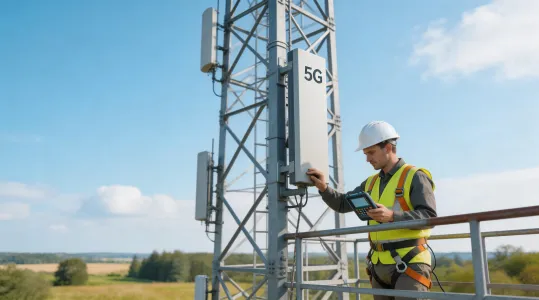
Telecom network testing

Telecommunications

5G NR validation, fiber acceptance testing, PIM measurement, cable & antenna sweep testing, and in-service monitoring for carrier-grade networks. Our instruments meet 3GPP and ITU-T compliance standards.

OTDR Spectrum Analyzer PIM Tester Cable & Antenna Analyzer
Get Industry Solutions Guide
Data center testing

Data Centers & Cloud

High-speed optical link certification, fiber characterization for 400G/800G upgrades, insertion loss and return loss measurement at scale. Support for Tier III and Tier IV facility standards.
OTDR Optical Power Meter Fiber Inspection Network Analyzer
Get Industry Solutions Guide
Manufacturing testing

Electronics Manufacturing

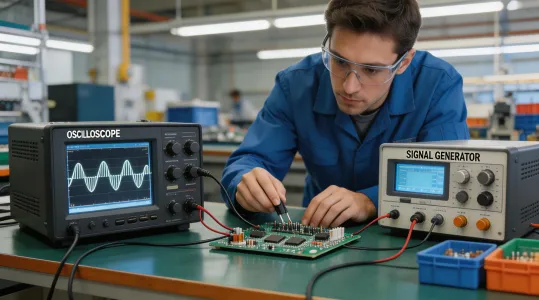
Production-line testing for RF components, cable assemblies, connectors, and PCBs. Automated test sequences, statistical process control integration, and MIL-STD compliance verification.

Network Analyzer Signal Generator Oscilloscope Power Meter
Get Industry Solutions Guide
Utility infrastructure testing

Utility & Energy

Fiber monitoring for smart grid SCADA networks, cable fault location, power quality analysis, and electromagnetic compatibility testing for substation equipment.
OTDR Cable Tester Power Meter Spectrum Analyzer
Get Industry Solutions Guide
Research and education

Research & Education

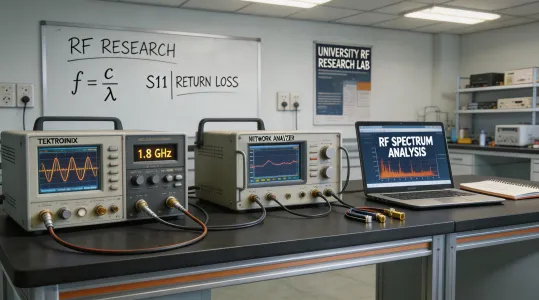
High-precision instruments for university labs, government research facilities, and R&D centers. Educational pricing and bulk deployment packages available for teaching labs.
Oscilloscope Signal Generator Spectrum Analyzer Network Analyzer
Get Industry Solutions Guide
Defense and aerospace testing

Defense & Aerospace

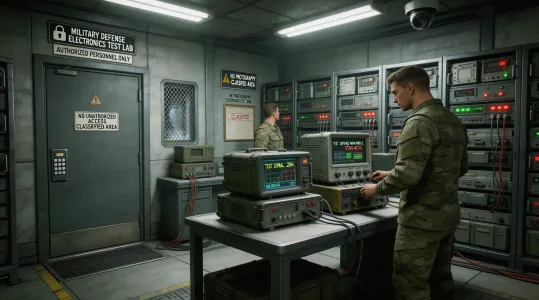
MIL-STD-810 rated instruments for harsh environments. EMC pre-compliance testing, radar signal analysis, and satellite communication link validation with security-cleared support teams.

Spectrum Analyzer Signal Generator Network Analyzer Cable Tester
Get Industry Solutions Guide

Selection Considerations: Common Technology Trade-offs

Choosing the right infrastructure involves trade-offs that depend on your deployment scenario. Here are two decisions our application engineers frequently help customers evaluate.

Fiber Optic vs. Enhanced Copper for Last-Mile Connectivity

Full fiber deployments (FTTH/FTTP) offer future-proof bandwidth capacity exceeding 10 Gbps per subscriber, lower long-term maintenance costs, and superior latency below 1 ms. However, the upfront deployment cost is 2-4x higher than leveraging existing copper plant with G.fast or VDSL2 vectoring, which can deliver 500 Mbps–1 Gbps over short loops (< 250 m).

When copper still makes sense: Brownfield deployments where duct access is limited, budget-constrained rural rollouts, and markets where current demand is below 500 Mbps. G.fast vectoring on existing copper can achieve 1 Gbps at distances under 100 m.

When fiber is the clear choice: Greenfield builds, multi-dwelling units with shared risers, and any deployment where the 15-year total cost of ownership matters more than Year 1 capital expenditure. Fiber also eliminates electromagnetic interference concerns near industrial sites.

National Instruments provides OTDR and copper qualification testers for both deployment paths. Our application engineers can help you select the right test plan regardless of medium.

5G mmWave vs. Sub-6 GHz Deployment Strategy

Millimeter wave (24–40 GHz) offers massive bandwidth — up to 800 MHz per channel — enabling multi-Gbps throughput and sub-1 ms latency ideal for industrial IoT, fixed wireless access in dense venues, and private campus networks. The trade-off: mmWave signals attenuate rapidly (path loss ~20 dB higher than sub-6 GHz at the same distance) and cannot penetrate most building materials.

mmWave priority scenarios: Stadium/venue densification, factory floor automation, campus fixed wireless access where line-of-sight can be maintained. Typical cell radius: 150–300 m outdoors.

Sub-6 GHz priority scenarios: Nationwide macro coverage, suburban and rural deployments, in-building penetration. Sub-6 GHz (e.g., 3.5 GHz n78 band) achieves 1–3 km cell radius with speeds of 100–900 Mbps.

Testing requirements differ significantly: mmWave deployments require beamforming verification, EVM measurement at higher modulation orders (256-QAM), and more frequent site surveys. Our spectrum analyzers and signal generators cover both bands.

Need a Custom Solution for Your Industry?

Our application engineers specialize in matching instruments to specific industry workflows. Let's discuss your requirements.

Contact an Application Engineer